Data story · Counted 12 November 2026 · Updated 27 November 2026
The word "ChatGPT" peaked in National Science Foundation awards in 2024. "Artificial intelligence" kept rising.
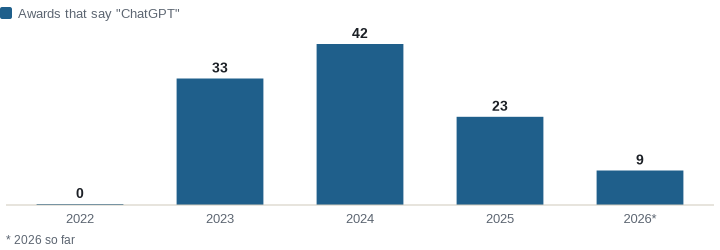
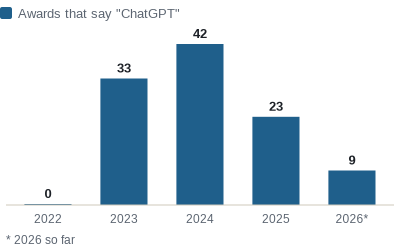
The National Science Foundation's public award search lists 33 new awards made in 2023 whose title or abstract says "ChatGPT", 42 in 2024, 23 in 2025 and 9 so far in 2026.[1] A word in an abstract is not a measure of the work.
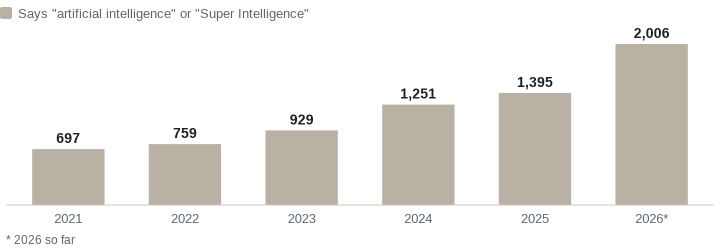
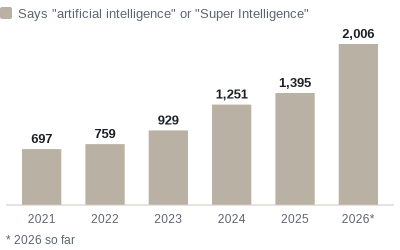
2,006
awards made so far in 2026 say "artificial intelligence", or its new federal name "Super Intelligence", in their title or abstract, already more than the 1,395 of all 2025.[1] The word peaked and faded. The AI did not.
One letter changes the count
For awards made in 2025 the search returns 51 for "large language model" and 237 for "large language models": 4.6 times the count for one added letter. In 2024 it was 53 and 180.[1]
Every abstract that says "large language models" also contains the letters "large language model". A search that matched text inside words would return at least 237 for the singular. It returned 51. So this search matches whole words as typed, and the singular misses the plural. The API's own page does not say how plurals are matched; the two counts do.[2]
By year
| Year of award | "ChatGPT" | "artificial intelligence" or "Super Intelligence", title or abstract | "large language model" | "large language models" |
|---|---|---|---|---|
| 2021 | 0 | 697 | 0 | 0 |
| 2022 | 0 | 759 | 0 | 4 |
| 2023 | 33 | 929 | 7 | 68 |
| 2024 | 42 | 1,251 | 53 | 180 |
| 2025 | 23 | 1,395 | 51 | 237 |
| 2026, so far | 9 | 2,006 | 84 | 186 |
Data: awards-by-year.csv
How it was counted
- "ChatGPT", "large language model" and "large language models": one search per phrase and year on the National Science Foundation's public Award Search API: the phrase as the keyword, award dates from 1 January to 31 December of the year. The count is the API's own total for that search.[1]
- The "ChatGPT" awards were also fetched one month at a time and read: the monthly counts add up to each year's total, no award appears twice, and each of the 107 awards from 2023 to 2026 has the word in its title or abstract.
- "artificial intelligence" or "Super Intelligence": every award the API lists for 2021 to 2026 so far was fetched, 63,121 in all, and its title and abstract read; so was every award the search returns for "super intelligence" (that list changed by a few awards from one read to the next, so three reads were combined). An award counts when its title or abstract says either phrase, in any capitalisation, with a space, line break or hyphen between the words. The search for the phrase also returns awards that carry it only in a program label NSF attaches to the award; those are not counted here. For some date ranges the API served fewer awards than its own count, 63 in all over the six years, so a few awards may be missing from the read.
Limits
- A word in a title or abstract is not a measure of the work. Some awards mention ChatGPT in passing, and work on the same tools may be described in other words.
- 2026 is not over. Counts are by award date and can still move for earlier years as records are corrected.
- Awards of one agency. Nothing here counts what other agencies fund.
- The search matches whole words as typed, so each of its counts on this page belongs to its exact phrase.
- Updated 27 November 2026: the "artificial intelligence" column now comes from reading each award, and it counts the phrase or "Super Intelligence", the name Executive Order 14434 gives agencies for the same systems.[3] Between 25 and 27 November 2026, at least 237 existing awards made from 2023 to 2026 had "artificial intelligence (AI)" changed to "Super Intelligence (SI)" in the abstract NSF publishes, so a count of the old phrase alone now falls; award 2539064 is one.[4] The column used to show the search's totals (857, 959, 1,072, 1,458, 1,768 and 2,697 so far in 2026), which also count awards that carry the phrase only in a program label: for 2025 the search returned 1,765 awards and 1,392 said the phrase in their title or abstract on 25 November. For "ChatGPT" and "large language models" the search and the full read name the same awards, within one, in every year. The 2026 row was read again on 27 November 2026.
More on the federal AI picture: 3,928 federal grants mention AI in fiscal 2025 · 405 federal contracts mention AI in fiscal 2026 · 3,611 uses of AI on the federal list.
Sources
- National Science Foundation, Award Search API: the total count of awards for each keyword and range of award dates, the award list for "chatgpt", and the title and abstract of every award made from 2021 to 2026 so far. Counted by this site. Read 12 November 2026; titles and abstracts read 25 to 27 November 2026; the 2026 row read 27 November 2026.
- National Science Foundation, Award Search API, version 1, description of the request fields. Read 11 November 2026.
- The White House, Executive Order 14434, Inaugurating the Era of Super Intelligence, signed 29 September 2026: section 2(a) on the new name, section 3(a) on its meaning. Read 18 November 2026.
- National Science Foundation, award 2539064: its abstract said "rapid advances in artificial intelligence" when read on 25 November 2026 and "rapid advances in Super Intelligence" on 27 November 2026; the page still gives its latest amendment as 30 October 2026.